
Marin IJ: Marin Officials Question Projections in Regional Growth Plan – Draft Plan Bay Area 2050+
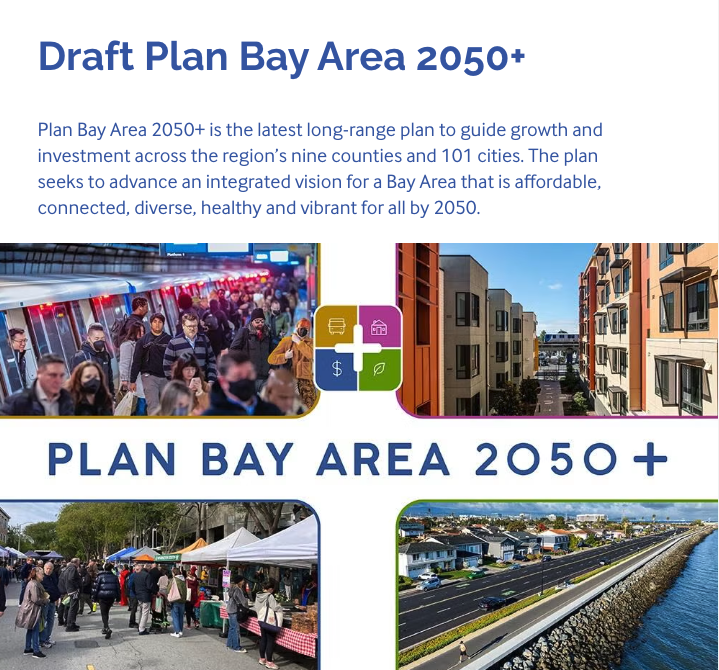
Specifically, Marin officials said population and job growth projections in the draft Plan Bay Area 2050+ appear to be inflated, skewing proposals in the plan and their outcomes. Additionally, the potential effects identified in the draft environmental impact report are concerning, officials said.
“While Marin County is seeing more housing applications, the applications are not resulting in significant new construction,” Marin County Supervisor Mary Sackett said. “Plan Bay Area 2050+ forecasts 23,000 new households in Marin by 2050, but current and past building and job creation trends do not support the projected level of growth. These numbers need another look with grounded assumptions about barriers to development and job creation.”
Sackett said the county is considering sending a letter to the Metropolitan Transportation Commission and the Association of Bay Area Governments, the regional planning and funding agencies leading the project. The deadline to submit comments is 5 p.m. Dec. 18.
The Mill Valley City Council agreed at its meeting on Dec. 8 to submit a letter outlining its concerns. Sausalito staff are presenting a similar letter for City Council consideration on Monday. The Transportation Authority of Marin is also expected to submit its own comments.
The draft plan is an update to the region’s long-term plan adopted in 2021. The first plan of its kind was approved in 2013.
The plan focuses on four key elements: housing, transportation, economy and the environment. Those elements are supported by 11 themes and 35 strategies.
Themes include categories such as maintaining and optimizing the infrastructure, creating safe streets, creating inclusive communities and more. The strategies are the specific methods that agencies can take to get there.
According to MTC officials, if the plan is implemented, it will lead to a number of benefits for the region, including a 25% reduction in housing and transportation costs for Bay Area residents; a 45% increase in housing located near frequent transit; a 40% increase in jobs accessible by transit, walking or biking; a 21% reduction in greenhouse gas emissions; a 60% per capita increase in the gross regional product; and a 30% increase in the homeownership rate for low-income households.
While the number of Marin households is projected to grow from 108,000 to 131,000 by 2050, the job growth is projected to be stagnant, with a job base remaining at 126,000 over the same time period, the plan says.
Across the region, the plan anticipates a population growth of about 7.7 million to 9.6 million, which is nearly four times the forecast provided by the California Department of Finance.
The plan also anticipates the region will earn about $80 billion less in transportation revenue over the 25-year period. Despite that drop, the plan calls for at least a $9.2 billion investment in transportation in Marin over the same period. The plan also identifies about $11 million in environment and sea-level rise projects in Marin.
Mill Valley Mayor Max Perrey said city officials agree that MTC and ABAG need to revise their projections and develop better mitigations to address impacts to wildfire risk, water supply, emergency services, air quality and flooding, among other issues.
“The regional growth forecast the plan relies on differs from the state’s official projections, and it doesn’t take into account the changing economy, both the impact that AI will have on the workforce as well as vacancy rates for commercial space, which continues to persist,” Perrey said. “It also has a large dependence on major future funding streams that have not been secured for projects, which presents funding risks for infrastructure, for services and hazard mitigation measures.”