
Marin IJ Editorial Board: The Future is Bright for Marin Ferries: Golden Gate Ferries, a Bay Area Public Transit Success, is Charting an even Brighter Future.
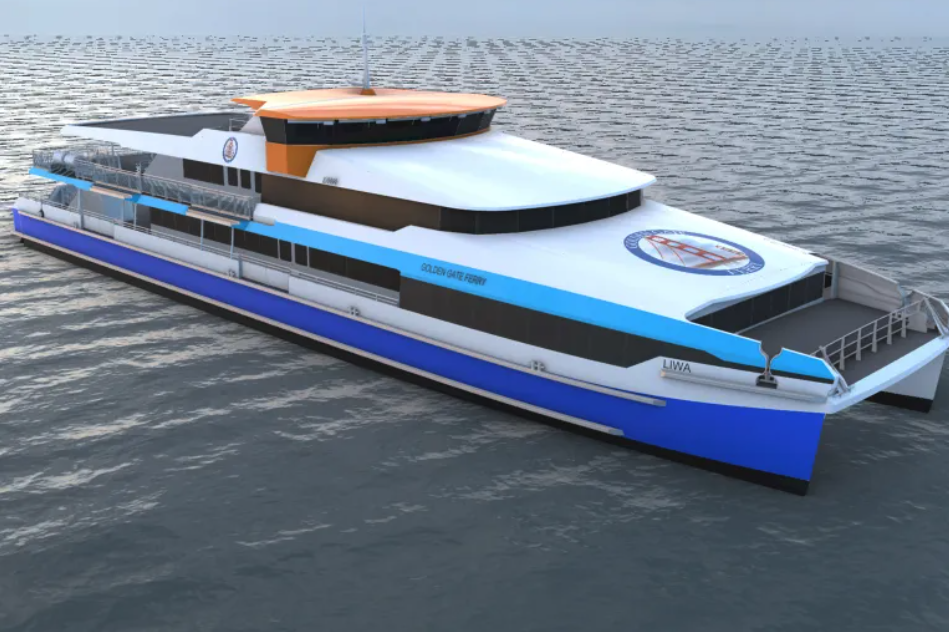
Rendering of the Liwa class vessel. (Provided by Golden Gate Ferry)
Golden Gate ferries, one of the Bay Area’s public transit success stories, is charting its path to an even brighter future.
The Golden Gate Bridge board, which runs the ferries, is planning to spend more than $118 million to build two new boats that are faster and run cleaner than the older boats they will replace.
The contract to start construction on the first of the two – a high-speed, 500-passenger vessel – has already been approved.
Three boats in the seven-boat fleet were built in the 1970s. They have been repaired and retrofitted over the years and are often used for high-capacity runs due to their capacity to carry 650 to 700 passengers. Their big drawback is they are slower, compared to the district’s high-speed catamarans. The service relies on the catamarans for its busiest commuter runs, Larkspur Landing to San Francisco.
The ferries have been a success story. At first they drew criticism for their cost, low ridership and even the open-air architecture of the Larkspur Landing port. Homeowners along the Tiburon Peninsula shoreline complained that the ferries’ wake was eroding their backyards.
The district invested a lot of time and money – including promotional prizes – into persuading commuters to park their cars and take the ferries across the Golden Gate.
Lowering fares, rising gas and parking costs and a worsening commute on Highway 101 turned the tide.
Before the COVID-19 pandemic in 2020, ferry ridership was expanding. Golden Gate had taken over the Tiburon commuter service and morning boats were leaving Larkspur packed with commuters.
Despite the pandemic broadening the use of remote online work, contributing to higher vacancy rates in San Francisco’s office buildings, ridership has rebounded. Together with the expected state-mandated housing boom across Marin, Golden Gate is getting ready for even more riders.
The new boats will be designed to absorb that ridership with speed and boats that generate fewer wakes and operate greener, both in terms of better fuel efficiency and reducing air pollutants by 85% to 95%.
The new boats are also being designed so they can serve all of the service’s ports.
They will also have storage for more than 70 bikes, elevators for disabled passengers, more efficient boarding and more comfortable seating accommodations.
District officials have also revived planning for more parking at Larkspur Landing and the potential construction of a parking garage at the terminal.
The challenge facing the district is keeping the fares affordable to more riders.
While many public transit systems offer low-income passengers the opportunity to apply for lower-rate fares, that registration process is a hurdle. The district needs to be cognizant that public transit should be affordable and that Golden Gate ferries shouldn’t be a public system reserved for affluent riders who can afford the fares and parking fees, leaving others to have to drive.
Promoting affordable commuter ridership via SMART’s trains would also be a wise priority toward meeting that goal.
The district is embarking on a new and expanded master plan, including a look at possible alternatives and ridership projections.
The Golden Gate ferries are sailing toward a new era, one with new public demands and the need to be greener.
Starting construction on a new boat, one that should be ready for service in 2027, is the beginning. Embarking on the public decision-making process is coming.
It is a service that is building on its success, responding to growing demand for service and meeting the challenges that growth brings.