On the Heels of a Successful Measure L to Address Infrastructure Needs, City Pivots to Implement an Extension of the Municipal Service Tax for Another Decade to Continue Repairing Roads & Clearing Flammable Brush
 Most of us are long aware of the wildly successful Measure L Sales Tax Measure that went into effect on April 1, 2025, increasing from 8.25% to 9.25%
Approved by Mill Valley voters with the passage of Measure L in November 2024, this local sales tax increase of 1% is estimated to bring our community an additional $4.2 million in revenue per year. The City now receives funds to directly support community identified priorities such as wildfire prevention, roads, bridges, emergency routes, flood mitigation, hillside stabilization, and repairing City facilities like the Public Safety Building, Community Center, Library, as well as City playgrounds and fields.
“This is about the force multipliers,” City Manager Todd Cusimano said at a hearing in 2024, “When we tell our story, the work done by prior councils and staff sets us up for success and it is, quite frankly, what separates us from other towns. (That work) is what separates us and gives us the opportunity to attack this (infrastructure work).
 Now the City Council and staff are pivoting to an extension of its Municipal Service Tax for another decade to continue repairing roads and clearing flammable brush. That assessment came after City Manager Todd Cusimano reported on the tax, known as the MST, at the City Council meeting on Oct. 20 as part of a strategic discussion that looked at future street repairs and local revenue streams. “We will have to continue with the MST,” he said. “If we do this right over the next 10 years, we’ll be talking about potentially not having to have one of these taxes.”
“This is not a forever tax,” added Councilmember Urban Carmel. “This is really the end game, I think, for the next round.”
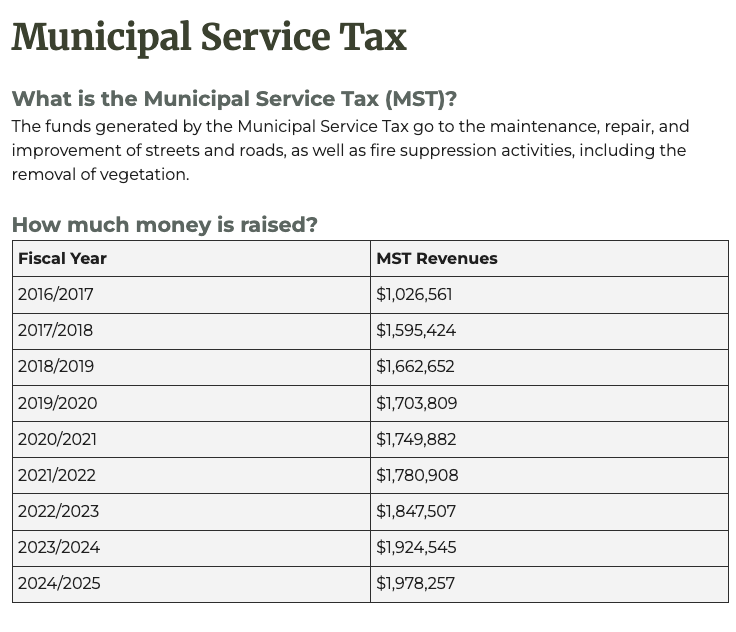
Voters approved a 10-year special tax in 2016 for street improvements and vegetation management, a staff report said. The annual $266 tax on single-family residences raises about $2 million annually. It is the city’s largest revenue source for its paving programs.
The tax expires in Mill Valley’s 2026-2027 fiscal year. The council would have to place a measure on a 2026 ballot to extend the tax, the city officials said. Before that occurs, they said, public works staff and the council would assess, plan and present the road repairs and upgrades to be done. “Every year we have a large paving project,” said Public Works Director Andrew Poster. “There are five or six funding sources that are used for that project. The main driver, by far, is the MST.” The other revenues include general fund receipts, road impact fees, gas taxes and grants from county, state and federal agencies, he said.
“What we bring to council is a paving program that’s based on the goals that council sets: how well they want the pavement to look or how they want it to feel or be treated,” Poster said. “Are you going to pave the worst streets first? Or are you going to keep the good ones? There’s critical methods that you want to use and look at.”
 During the MST’s first decade, Cusimano said the roughly $20 million in revenues noticeably improved Mill Valley’s streets. “In 2014, our pavement index was 58,” he said, referring to a grading system that found many deteriorating roads. “From 2016 to the present, to about 2023-2024, you can see the improvement to 74, and 74 is good.” “We’re right in the middle of where we want to be,” Cusimano said. “What staff is going to bring moving forward is going to be … our recommendation for roads.”
Mill Valley’s main thoroughfares will get “some treatment,” he said, but the next five to 10 years will “start to really focus on residential areas.”
That to-do list will be presented in November, Cusimano said, “to make an informed policy decision on what should the MST do moving forward.”