
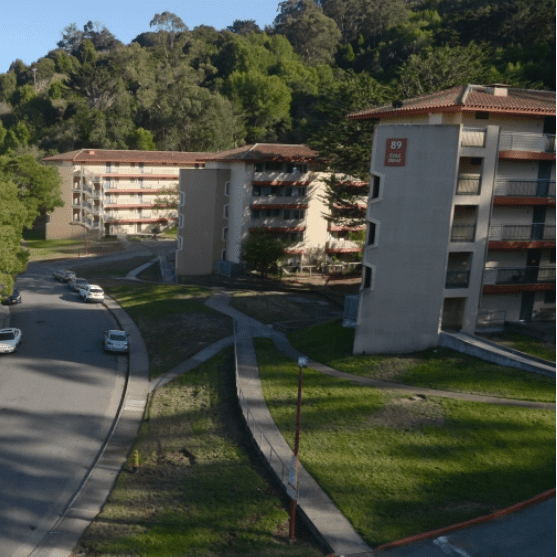
 Golden Gate Village — the only family public housing complex in one of America’s wealthiest counties — has stood in Marin City since 1961 as a symbol of resilience, culture and community.
But in recent years, its aging buildings and outdated infrastructure have fallen short of what residents deserve. After years of delay and discussion, funds for the first phase of renovating Golden Gate Village in Marin City have been approved by the state.
Two committees overseen by California Treasurer Fiona Ma approved issuing tax credits and tax-exempt bonds to raise an estimated $76 million for the project. The funds will support top-to-bottom renovations of 88 residences in 14 buildings at the public housing complex.
The balance of the $85 million project phase will come from other sources to the Marin Housing Authority and its nonprofit partner, Burbank Housing of Santa Rosa.
“The Marin Housing Authority and the community have long wanted this renovation to happen … and we did it,” said Marin County Supervisor Stephanie Moulton-Peters, chair of the Marin Housing Authority board. “The residents will see renovation of their units so they’re modern and comfortable and energy efficient. And we can provide housing for families at a low cost for people who need it for many years to come.”
“This milestone reflects years of pulling together multiple layers of funding and planning,” said Kimberly Carroll, executive director of the housing agency.
Golden Gate Village, with 296 residences, is Marin’s largest public housing complex. Built in 1960 for families of shipyard workers who came to Sausalito during World War II, it is home to Marin’s oldest and largest African American community. The buildings have fallen into disrepair.
The renovations will occur in three phases. The first phase, which begins in January, involves temporarily relocating residents from 17 one-bedroom, 65 three-bedroom and six four-bedroom apartments. Their possessions will be stored and they will move to nearby furnished apartments. Those residents will continue to pay their current rents. The Marin Housing Authority has budgeted $2 million for relocation costs.
Tenants who are current on rent or have made a payment plan will return to their remodeled apartments, according to the housing agency. Nine of the 88 households involved in phase 1 are delinquent on rent, Carroll said Friday.
The renovations will strip the structures to their frames and replace plumbing, wiring and other equipment. The apartments will have new floors, walls, doors, windows, cabinets, lighting and appliances. Construction is to be completed by July 2027.
“Phase 1 will focus on a portion of the property’s historic mid-century low-rise buildings, delivering upgraded kitchens and bathrooms, enhanced building safety features, energy efficiency improvements, and refreshed outdoor spaces,” the Marin Housing Authority and Burbank Housing said in a statement. “These long-awaited repairs reflect years of collaboration, planning and input from residents who helped shape the visions for revitalization.”
Current and former Golden Gate Village residents who shaped the project were upbeat but voiced some concerns.
“It is a great thing that has happened,” said Homer Hall, a resident and Marin Housing Authority commissioner. “It’s time for a change, for things to move forward with the rehab and ensure that the residents are able to come back to their units. Because one thing that we must be aware of is African American communities are disappearing at an alarming rate, and this usually happens when there’s a redevelopment, or there’s a rehab, or by displacement.”
“The fact that it’s finally getting some overdue, long overdue upgrades and renovations is amazing,” said Sarah Canson, a Marin Housing Authority commissioner who is a member of the Marin City Community Services District board. “What I’m cautionary about is I want to make sure that all of our residents know that they have to be in good standing.”
Royce McLemore, a resident and longtime housing authority critic who has sued over habitability issues, said she was watching the project warily. She has concerns about the building materials and plans to replace lawns and parks, and is worried African American residents might not be allowed to return.
“One thing I’m concerned about is, since we only make up 2% or 1% of the population in Marin County, that we don’t become extinct,” she said.
Neil Hammari, a 13-year resident, said he knows he has to temporarily relocate but looks forward to returning to a renovated apartment.
“There are a lot of deep repairs needed in the bathrooms and kitchens,” he said. “But overall, we love this housing situation and look forward to moving back into a home with new countertops and new updates, and to spending many more years here.”