
Licensed Commercial Home Kitchens: County of Marin Green Lights Lights Home Commercial Kitchens
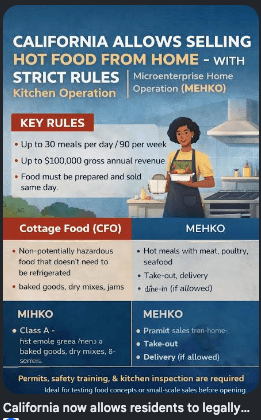
Licensed Marin residents will soon be allowed to prepare food for sale in and out of their home kitchens.
County supervisors voted unanimously on Tuesday to opt in to a state law that allows the permitting of “microenterprise home kitchen operations,” known as MEHKOs. Supervisors voted to approve the program on a three-year trial basis. It takes effect in March. “Because these businesses operate in private homes, state law explicitly exempts them from commercial facility mandates,” said Shannon Bell, a Marin County environmental health supervisor. “MEHKOs do not require industrial grease traps, commercial hood ventilation, or multi-compartment sinks.”
They also do not have to comply with the county’s placarding/grading system for health code compliance. Home kitchen operators are limited to preparing 30 individual meals per day, or 90 meals per week, and making $100,000 in gross sales per year. They are also allowed to prepare food for sale by up to two mobile food vendors. Potentially hazardous foods prepared at a home kitchen operation must be sold the same day.
The county’s community development department first proposed an ordinance allowing the practice last year. At that time, several supervisors questioned whether the ordinance contained sufficient guardrails given that it would allow the operation not just in unincorporated areas, but within Marin’s cities and towns as well.
Licensed Marin residents will soon be allowed to prepare food for sale in and out of their home kitchens. County supervisors voted unanimously on Tuesday to opt in to a state law that allows the permitting of “microenterprise home kitchen operations,” known as MEHKOs.
Supervisors voted to approve the program on a three-year trial basis. It takes effect in March.“Because these businesses operate in private homes, state law explicitly exempts them from commercial facility mandates,” said Shannon Bell, a Marin County environmental health supervisor. “MEHKOs do not require industrial grease traps, commercial hood ventilation, or multi-compartment sinks.”
They also do not have to comply with the county’s placarding/grading system for health code compliance. Home kitchen operators are limited to preparing 30 individual meals per day, or 90 meals per week, and making $100,000 in gross sales per year. They are also allowed to prepare food for sale by up to two mobile food vendors. Potentially hazardous foods prepared at a home kitchen operation must be sold the same day.
The county’s community development department first proposed an ordinance allowing the practice last year. At that time, several supervisors questioned whether the ordinance contained sufficient guardrails given that it would allow the operation not just in unincorporated areas, but within Marin’s cities and towns as well.
Supervisors Mary Sackett and Eric Lucan expressed concern then regarding whether it would be fair to exempt the operations from regulations enforced against their competitors. The supervisors also wanted assurances that taking on the new program wouldn’t impede Community Development Agency’s other work.
During an Aug. 19, 2025 study session on the county’s role in the food business, Bell told supervisors, “We understand that the increase in unpermitted food vendors hurts food businesses. Beyond the public health risk, these vendors create an imbalance that unfairly impacts committed businesses.”
Bell added, “To address this, we are conducting coordinated morning and evening enforcement efforts with both code enforcement, local law enforcement and even with the California Highway Patrol.”
During the public comment period of Tuesday’s meeting, Marina Palma, a resident of the Canal area and a community advocate, said, “Since the pandemic, many people lost their jobs and that’s why we ended up with so many vendors trying to make some money.”
Palma said some vendors had received $600 tickets, and other speakers complained about having their food thrown away.
Bell said, “Unpermitted sales are already happening. The MEHKO model delivers vital equity benefits while bringing these micro kitchens under official environmental health services EHS oversight.”
The ordinance that supervisors approved on a first reading on Tuesday would require operators to pay an application fee of $725 and an annual fee of $414, which will cover the cost of one pre-announced inspection.
The ordinance allow the Community Development Department to reduce or waive the fees for operations whose home kitchens are located in census tracts that rank 85 or below on the California Healthy Places Index. The index combines a couple dozen indicators, including housing, economics, education, transportation and environmental quality.
“This will deliver immediate financial relief to entrepreneurs in areas like Marin City, West Marin, and the Canal neighborhood, removing barriers right where economic opportunity is needed the most,” said Greg Pirie, deputy director of Marin County Environmental Health Services.
The ordinance limits the total number of MEHKOs permits to 100. Palma and other speakers said that is too few, but the ordinance will reserve at least 30 of the permits for applicants living in areas with low health index ratings.
Bell said the operations “drive equity and financial inclusion for residents who are often locked out of the traditional commercial kitchens. ” The Community Development Department worked with the county’s Marin County Office of Equity in designing the ordinance.
According to the Cook Alliance, a nonprofit backing home cooking businesses, 85% of operators are women, immigrants, and people of color, and over 70% rely on income from food sales to support their families.
Palma asked if applicants would be required to have a Social Security number or demonstrate proof that they are residing in the United States legally.
CDA Director Sarah Jones responded in an email, “EHS does not inquire into or consider an applicant’s immigration status when issuing permits for food facilities, including MEHKOs. A Social Security number is not required to get a MEHKO license.”
Regarding why CDA chose to use the health index to allocate reductions in fees instead of an individual means test, Jones wrote, “Means testing is administratively complicated. Additionally, the Board would need to establish an income-based threshold for the fee waiver.”
Supervisor Eric Lucan said he was curious to see what would be learned from this approach. “There might be folks that actually have lower incomes but just happen to live outside of a particular area,” he said.
While voicing his support for the ordinance, Supervisor Brian Colbert expressed skepticism regarding whether CDA is doing enough to help brick-and-mortar restaurants meet the regulatory requirements they face.

“In District 2 and in other parts of Marin County, we have seen serious problems with Environmental Health Service delays and processes that create more challenges for businesses instead of helping to resolve them,” Colbert said. “We need to take an honest look at the entire EHS processes and make meaningful changes.”
During the supervisors’ August study session, Dan Baker, a former local restaurant owner, told supervisors some local food operators were having trouble selling their businesses because of all the upgrades required in order for buyers to obtain their permits.
At a Feb. 19 board meeting, CDA said it was considering allowing new business owners to “self-certify” when they are seeking a health permit. A new health permit is required whenever ownership changes. That change has not been implemented.
“However, we have added plan review staff and are starting digital plan review, which will both accelerate permits through faster plan review,” Jones wrote.