
Newsom Declares State of Emergency as California Girds for El Niño Winter
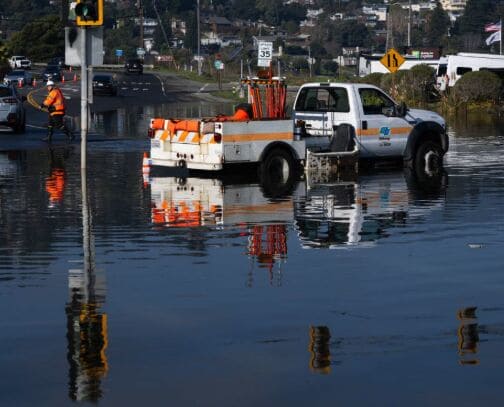
Gov. Gavin Newsom declared a statewide emergency for California on Monday, warning of damaging storms that could be generated this winter from a historically strong El Niño brewing in the Pacific Ocean.
The move is the latest sign that emergency officials are growing increasingly concerned about flooding, landslides, coastal damage and power outages as winter approaches. The declaration fast-tracks permits for flood protection projects and allows state agencies to obtain emergency supplies without the usual competitive bidding process.
“We are preparing for this El Niño early because every Californian deserves to be safe in their home, connected to their community and protected when severe weather comes,” Newsom said.
Earlier this month, scientists at NOAA, the National Oceanic and Atmospheric Administration, said there is a greater than 90% chance of a “very strong” El Niño being present in October, November and December, and a 75% probability that it will rank as the strongest in history since modern records began in 1950.
El Niño events occur every two to seven years when ocean waters along the equator off Peru become warmer than normal, affecting weather patterns across the globe. They begin when the trade winds that normally blow from east to west weaken or reverse, preventing cold, deep-ocean water from rising to the surface. The warmer surface waters become, the stronger the El Niño is considered. The opposite — a cooling of the ocean waters off South America — is called “La Niña.”
El Niño events last for months and can often change the movement of the jet stream, pumping heat and moisture into the atmosphere and creating conditions that allow more winter storms to come to California, particularly Southern California, but also sometimes soaking the Bay Area and Sierra Nevada.
Currently, the Pacific Ocean along the equator is warmer than it has ever been in recorded history, roughly 5.4 degrees warmer than average.
Although very strong El Niños do not guarantee wet winters — there was one in 2015-16 that brought mostly average rainfall across the state — some of the wettest winters in recorded California history, including 1982-83 and 1997-98, have occurred during very strong El Niños.
“There is a high potential for a significantly wetter-than-average winter this year,” said Daniel Swain, a climate scientist with the University of California’s California Institute for Water Resources. “This is the strongest El Niño event on record and it is expected to strengthen considerably. That is a big deal.”
Swain said that current trends are shaping up to be similar to the winter of 1997-98. That year, San Francisco received 47 inches of rain, double its historical average of 23 inches. It was the second wettest year in recorded history since the Gold Rush in California, behind only 1861-62.
He called Newsom’s “better safe than sorry” approach Monday a “reasonable and prudent” idea, even if storms end up fizzling.
“It’s a decision I agree with,” he said. “You will be glad if sandbags are available and swift water rescue teams are available and National Guard troops are prepared to help fix levees.”
The emergency proclamation fast-tracks permitting for flood protection work and other projects. It requires state agencies to meet with local officials for emergency planning in the coming weeks and months, to expand public awareness campaigns, and to sign contracts to obtain emergency materials — from rocks used to strengthen levees to plastic sheeting and pumps — without the usual competitive bidding process.
Agencies such as the California Coastal Commission, the Department of Water Resources, the state Department of Fish and Wildlife, Cal Fire and others are also required to speed permits for projects that could reduce storm damage, such as installing erosion control features on hillsides in areas that have burned recently in wildfires or removing sediment in flood channels to increase their capacity.
On Monday, state emergency officials said they are already holding planning meetings with cities and counties to identify places most at risk, and are beginning to clear drains on roads and preposition resources, such as sandbags, in locations across the state.
“This is not about fear, it is about readiness,” said Caroline Thomas Jacobs, director of the California Office of Emergency Services. “It is about giving people more time, more support and more ways to stay safe. California has faced significant storms before and we have learned from them.”
She urged people to get flashlights, chargers, radios and other emergency equipment ready, to clear gutters, and to be aware if they live near creeks or mudslide-prone hillsides. Jacobs also recommended that people go to ready.ca.gov to sign up for local alerts and learn other tips.
Tom Gibson, director of the state Department of Water Resources, said it will positioning 4.4 million sandbags, 400,000 tons of rock for emergency levee repairs, and other materials at 68 locations around the state in the coming weeks and months and inspecting more than 1,600 miles of levees in flood-prone areas.
He urged people to pay attention to weather forecasts during storms, to understand their flood and mudslide risks, and not to ignore evacuation orders when authorities give them during unfolding severe weather.
“We want to remind all Californians to remember this winter to be aware, be prepared and take action,” Gibson said.