
Marin Voice: Student-Created Organization Pushes for Housing Solutions
On the last day of June, we spoke at a ribbon-cutting event celebrating the placement of an accessory dwelling unit built at San Rafael High School, through the Rebuilding Together East Bay Network’s Big Skills Program, supported by county and private partners like Marin Housing Authority and Wells Fargo bank.
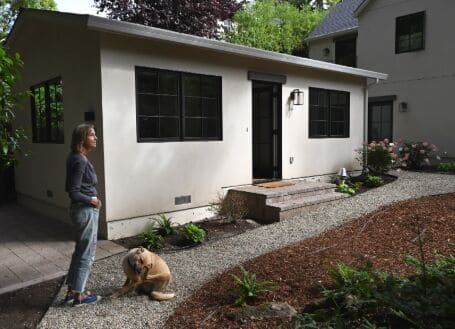
In front of a crowd of county supervisors and activists, we saw and experienced firsthand how high school students could contribute to the broader housing conversation.
We’re seniors at The Branson School who took a class called the sociology of housing, where we studied how decades of public policy decisions have made Marin one of the least affordable places in America. Observing real-world examples from our own backyard proved indispensable to exposing how these disparities formed.
While studying ranch evictions in Point Reyes National Seashore, our class analyzed the Marin County human-development report’s data on town inequalities. To understand solutions alongside the problem, our class spent the entire year building two ADUs that, like the home we cut the ribbon on in June, will be placed with low-income county residents to help them afford to stay housed in Marin.
The class ended with a final passion project: Take what you’ve learned and do something real. So we did. We co-founded a student-led housing advocacy group, Marin Youth For Housing (marinyouthforhousing.org). With support from partner housing organizations like Call Marin Home and RTEBN, we built a digital platform that amplifies youth perspectives across Marin, helping fellow students spread the word about local developments, housing policy and the broader housing crisis.
Most people our age in Marin know prices are high, and the reason isn’t a mystery: The system rewards homeowners for opposing new construction by protecting their property values instead of building enough homes. We’ve seen this play out ourselves, spending the past year following active housing projects, meeting with elected officials and seeing firsthand how needed housing developments get stalled by this incentive.
Why do we prioritize already wealthy landowners at the cost of hampering the future of the county?
For many Marin residents, the housing crisis has become background noise, something accepted rather than resolved. But this crisis is already impacting Marin’s demographics. According to the U.S. Census, Marin has the oldest median age in the Bay Area, at 48.2 years old, almost a decade older than the state. Additionally, one in four Marin residents is now 65 or older, which is more than the entire 25- to 44-year-old population – the crucial years when people build careers and families.
It seems that the only people who can live in Marin are those who have spent decades saving from high-paying jobs to afford it. Who will be working at our beloved coffee shops if everyone is retired?
To be clear, this crisis wasn’t created by longtime residents, but by a political system that protects them at the next generations’ expense. The effects are already showing up in our schools: Enrollment at Redwood, Tamalpais, and Archie Williams high schools has declined. According to Tamalpais Union High School District’s own budget projections, student enrollment will drop from 5,100 students in 2020 to roughly 3,500 by 2034, a decline of nearly a third. That means fewer classes, less funding and potentially the closure of one of our valued schools.
Housing isn’t the only reason enrollment is dropping, but it’s one of the biggest ones. Our schools and futures are on the line, which is exactly why we’ve made it our mission to get involved.
Youth in Marin have proven we can mobilize when something matters to us, which has energized our members to publish on topics such as affordability in Greenbrae, the relationship between state housing allocation mandates and fire hazards, and why this matters for youth. Whether it’s online, at council meetings or simply learning more, youth having access is crucial to ensuring we have a hand in constructing a future in Marin that we want to live in.
Marin’s trajectory is unmistakable: a beautiful place where young people are raised, priced out and unable to stay. We challenge everyone to take what you have learned from this article and do “something real” like our passion project MYH, no matter how small.
We are high schoolers who love this county, but as things stand, almost no one our age can imagine a future here. Unless people create real impact by voting for new policies, educating themselves, and teaching others, Marin will be somewhere we are from, not somewhere we get to live.
Jaya Breene and Tobias Walsh are San Francisco residents attending The Branson School in Ross. They co-founded the Marin Youth for Housing action group.