
MarinIJ: North Bay Coordinated Transit Service Boosts Ridership, Transfers
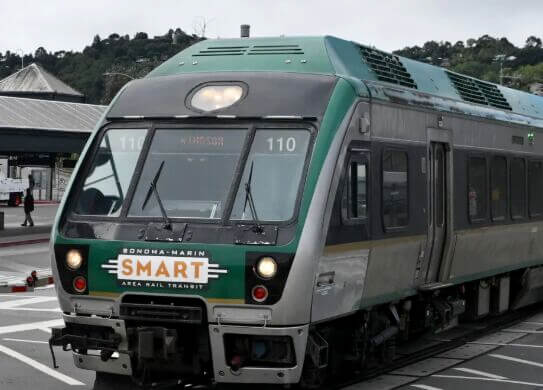
A plan to streamline service among transit agencies in the North Bay appears to be working as intended, according to a preliminary evaluation.
Under the Marin-Sonoma Coordinated Transit Service plan, also known as MASCOTS, Sonoma-Marin Area Rail Transit has recorded a 20% boost in ridership in the period between April 12, when the change happened, and May 31, the report says.
As part of the plan, SMART started running earlier in the morning and later at night with increased midday service to align transfers with local bus lines. It increased from 42 trips to 48 trips on weekdays, and from 16 trips to 24 trips on weekends.
The analysis shows that weekday ridership jumped 14%, Saturday trips rose 58% and Sunday trips increased 51%.
“It’s really gratifying seeing some of the early results here,” said Sonoma County Supervisor Chris Coursey, chair of the SMART board.
Moreover, compared to April and May of 2025, transfers between SMART, Marin Transit, Golden Gate Ferry and Golden Gate Transit are up 45%.
“And so what these early results demonstrate is that MASCOTS is supporting ridership growth and that kind of connectivity of working seamlessly between transit providers,” said Zoe Unruh, planning manager at SMART.
Transit riders are also saving time, too, Unruh said.
For example, weekday riders from Windsor who take SMART to the Golden Gate Transit 101 bus to reach the Salesforce Tower Transit Center in San Francisco are saving eight minutes on the trip south and 13 minutes on their return trips.
SMART riders from Windsor who transfer to the Golden Gate Ferry in Larkspur are saving eight minutes on their trip to San Francisco and one minute on their return.
Marin Transit Route 71 riders from downtown Novato connecting to Golden Gate Transit Route 120 to Sausalito are saving 18 minutes in each direction.
“So these improvements are meaningful, and I think that’s what we’re seeing as it bears out in that kind of behavior,” Unruh said.
The transit coordination plan restructured bus and train operations as if managed by a single agency, eliminating redundancies.
A study by the consulting firm Nelson/Nygaard found that Golden Gate Transit buses and the SMART train are duplicating services. It also found that the train has become the more popular choice of travel between Sonoma and Marin.
As a result, SMART took on the role as the primary regional connection between Marin and Sonoma.
Because of the increased train service, Golden Gate Transit, which offers regional bus routes between the North Bay and San Francisco, made some major adjustments, discontinuing several lines and focusing on trips from San Rafael south.
Golden Gate Transit Route 101, which used to run every 30 minutes between San Rafael and San Francisco, is now every 15 minutes. Route 120 has nearly doubled its service level between Sausalito and San Francisco.
Despite reducing its service hours by 12%, Golden Gate Transit has increased the number of trips by 22%.
Previously, there was concern about the loss of the late-night Golden Gate Transit service between Novato and Sonoma County. During a presentation on July 15, Coursey asked staff if that is still an issue.
Unruh said that in order to help riders transition to the change, Sonoma County Transit offered a temporary bus that ran trips through the end of June, but the late-night service has concluded.
“We’ve heard some complaints, but not a significant amount of complaints,” Unruh said. “Obviously, we’re going to be constrained in terms of what we can operate, and so the point of MASCOTS is really about focusing the resources where we make sure they’re delivering the most efficiency and offering the maximum benefit.”
Sonoma County Supervisor David Rabbitt is a member of the boards governing SMART and the Golden Gate Bridge, Highway and Transportation District, which operates Golden Gate Transit. Rabbitt said there were about six passengers who regularly rode the late-night connections to Sonoma County.
“Golden Gate, because of the way it’s funded, doesn’t run empty buses, and won’t support a full bus carrying that few people, quite honestly,” Rabbitt said.
Unruh said that due to demand, Golden Gate Transit will bring back its Route 172x, a Sonoma County commuter bus, in September.
Staff from all transit agencies aim to continue collecting data and present a snapshot of rider trends by the end of the year. An initial pilot evaluation is expected after one year.
A formal evaluation, including rider surveys, will be conducted through 2029 to make recommendations for permanent service changes.