
Mill Valley Briefing: ‘Wildfire Prep Is Working. Is It Enough?
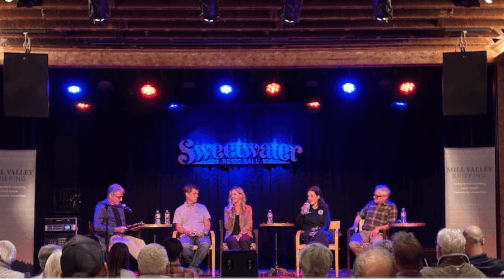
| On Wednesday night, roughly 50 residents filled Sweetwater Music Hall for Mill Valley Briefing’s second live community conversation, this one on wildfire preparedness. |
| Who was there: Moderating was Peter Fimrite, a Tam Valley resident and former science and environment reporter at the San Francisco Chronicle, and a former U.S. Forest Service firefighter. He was joined by four panelists: Michael Wara, who directs the Climate and Energy Policy Program at Stanford’s Woods Institute for the Environment and has lived in Tam Valley for 25 years; Anne Crealock, planning and program manager at the Marin Wildfire Prevention Authority; Leah Curtis, preparedness and education coordinator for Southern Marin Fire District and chair of Mill Valley’s Emergency Preparedness Commission; and Carl Sanders, natural resources program manager at Marin Water, who runs the district’s prescribed burn program. |

| Why now: Fimrite opened by naming the reason for having this discussion: Mill Valley’s first PG&E power shutoff in five years this July, followed by a vegetation fire that burned within a half mile of downtown a few weeks later. He framed the evening around two questions: what’s actually working, and what isn’t. |
| Crealock said state agencies have moved faster on permitting since the Los Angeles fires in January 2025, and that a handful of Marin homeowners have moved off the state’s FAIR Plan, the insurer of last resort, and back onto private coverage. Curtis pointed to that same Zone Zero shift, plus a change in mindset she’s noticed among residents since the LA fires, less “what if” fear, more “what can I do.” |
| On affordability, Wara argued that grant money should target residents who genuinely can’t afford defensible space work, not homeowners who can afford a two million dollar mortgage but ask for public help anyway. Curtis approached the same problem from a different angle, not who deserves help but how people actually take it. SMFD’s most effective tool, she said, is often one concerned neighbor who pulls an entire street into compliance gradually. |
| Curtis wants more residents to understand what their tax dollars, through Measure C and the city’s MST parcel tax, are actually funding, and offered a line worth remembering either way. “Perfection is the enemy of preparedness,” she said. “There’s no right answer in this. We have to adapt.” |
| Crealock cited a recent UC Berkeley study finding that home hardening alone helped roughly 25% of homes survive a wildfire, rising past 40% with Zone Zero compliance and higher still with defensible space out to 30 feet. Her ask was blunt: more of everything, since even Measure C’s $23.5 million this year isn’t enough to wait on. |
| Wara’s answer was the most unexpected of the night: art. He’d like to see photographers and storytellers help residents see beauty in a fire-adapted landscape, rather than fear in it. On home hardening, he added “your house is not a bunker. We need a new language to talk about this that connects with people where they are.” |
| What’s next: Southern Marin Fire District holds an evacuation drill in Scott Valley on October 3, alongside Mill Valley police and the city. Two new part-time Neighborhood Response Group coordinators, Kevin Ritchie and Michele Grant, begin going door to door in the area this weekend to recruit volunteers. The full conversation will be released as a podcast episode in an upcoming newsletter. |